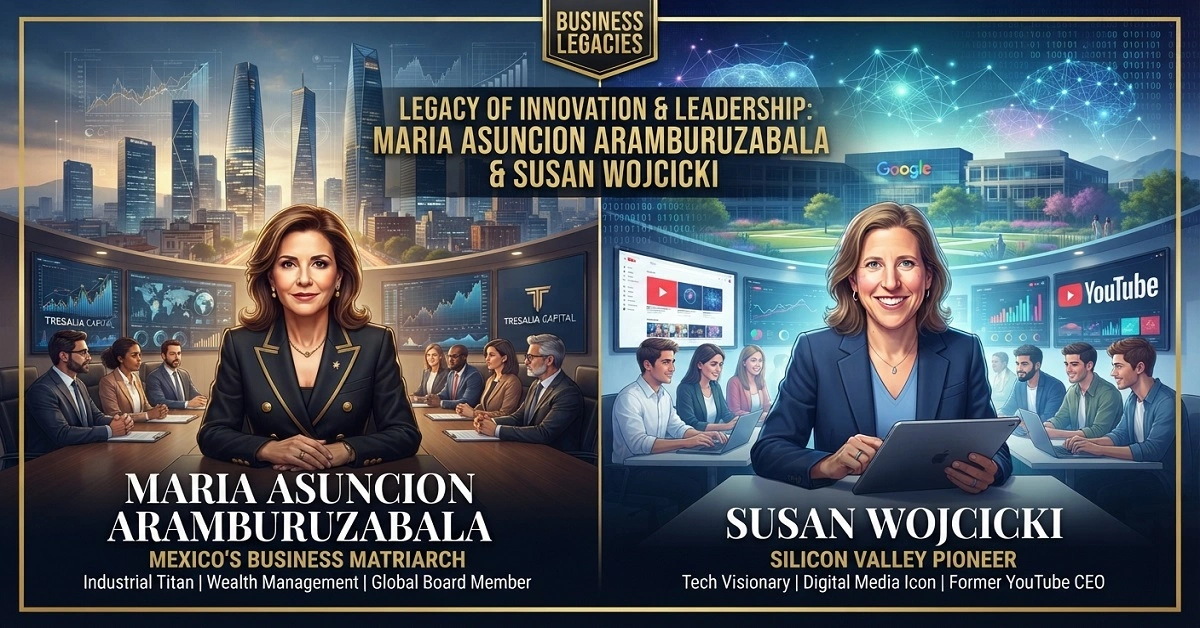
The historical intersections of global wealth management and internet technology are perfectly exemplified through the contrasting yet equally brilliant corporate journeys of maria asuncion aramburuzabala and susan wojcicki, two female leaders who dismantled structural gender barriers across multi-billion-dollar industries. In a business world historically dominated by male-led family dynasties and corporate hierarchies, these two icons constructed lasting legacies of leadership, operational excellence, and innovation. One navigated the intricate, high-stakes waters of traditional Latin American conglomerate capitalism, safeguarding an industrial empire, while the other provided the foundational physical and strategic spaces that catalyzed the modern Silicon Valley landscape. This exhaustive dual biography chronicles their lives from early upbringing to their enduring professional global impact.
Understanding the socio-economic impact of these business leaders requires tracing how they leveraged their initial access into transformative platforms. For decades, institutional barriers prevented women from occupying core executive and board positions in primary industrial sectors. However, by combining analytical rigor, uncompromising work ethics, and bold strategic investments, both individuals successfully created massive financial networks and digitized creator economies that redefined consumer habits. Their parallel stories offer blueprint strategies for modern corporate resilience, capital allocation, and inclusive operational leadership, demonstrating that visionary female governance permanently restructures corporate outcomes on a global scale.
The Foundations of Leadership: Family Roots and Early Life Accounts
Born into a prominent dynasty in Mexico City in 1963, Maria Asuncion Aramburuzabala was raised surrounded by industrial enterprise. Her grandfather, Felix Aramburuzabala, co-founded Grupo Modelo, the brewery company responsible for global brands like Corona. Growing up, she observed her father, Pablo Aramburuzabala, manage the expanding beverage business with operational precision. This constant exposure to large-scale supply chain logistics, distribution matrices, and executive decision-making laid a robust foundation for her analytical business mindset. She pursued her formal higher education at the prestigious Instituto Tecnologico Autonomo de Mexico (ITAM), graduating as an accountant.
Conversely, Susan Wojcicki was born in 1968 in Santa Clara County, California, deeply embedded within an academic and intellectual environment. Her mother, Esther Wojcicki, was an educator and journalist, while her father, Stanley Wojcicki, was a prominent physics professor at Stanford University. This background fostered a culture of deep intellectual curiosity, rigorous analysis, and a creative approach to problem-solving. Growing up on the Stanford campus, she was exposed early on to the rapid development of computational technologies and academic theory. She later attended Harvard University, graduating with honors in history and literature in 1990, before redirecting her academic path toward economics and business administration.
| Attribute | Maria Asuncion Aramburuzabala | Susan Wojcicki |
| Birth Date & Place | May 2, 1963; Mexico City, Mexico | July 5, 1968; Santa Clara County, California |
| Family Matrix | Industrial legacy; Granddaughter of Grupo Modelo co-founder. | Academic legacy; Daughter of Stanford physics professor. |
| Initial Education | Accounting Degree from ITAM (Mexico). | BA in History & Literature from Harvard University. |
Corporate Warfare and Breakthrough Moments in Mainstream Markets
The defining moment for Maria Asuncion Aramburuzabala arrived unexpectedly in 1995 when her father passed away from cancer. In the wake of this loss, various external investment groups and hostile corporate factions attempted to marginalize her family’s control. Showing exceptional strategic grit, she united with her mother and sister to form an unyielding corporate front, taking the reigns of the family’s assets. She systematically restructured internal administrative systems, streamlined manufacturing lines, and successfully warded off corporate raiders. Her decisive actions culminated in securing a prominent vice-chairmanship position at Grupo Modelo, proving her capability to manage a major enterprise.
For Susan Wojcicki, her breakthrough occurred in 1998 when she made the decision to rent her newly purchased garage to two Stanford students. Those students, Larry Page and Sergey Brin, were developing an initial mathematical search engine algorithm called Google. Recognizing the massive latent potential of the digital internet space, she joined the young startup in 1999 as its 16th official employee. Operating as Google’s first marketing manager with a near-zero budget, she spearheaded the monetization of search traffic. Her foundational work on Google AdSense transformed the internet, proving that web search traffic could be scaled into an immensely profitable corporate advertising model.
Investment Dominance vs. Tech Innovation Execution Strategies
The broader long-term economic influence of maria asuncion aramburuzabala and susan wojcicki expanded through completely unique models of resource management. Aramburuzabala founded Tresalia Capital, a family-backed private equity firm built to diversify her capital beyond the brewing sector. Under her management, Tresalia pioneered capital injections into expanding telecommunications networks, real estate developments, and tech infrastructure. Her investments reached global retail brands, infrastructure projects, and banking institutions, showcasing her multi-sector financial acumen. Her strategy prioritized structural wealth longevity, asset protection, and identifying high-growth manufacturing companies across Latin America and international markets.
She designed the monetized partner system, allowing millions of global creators to earn income directly from videos. Her strategic execution scaled YouTube into a multi-billion-dollar media platform that completely shifted advertising budgets away from traditional broadcast television.
Navigating Traditional Mexican Conglomerates
Aramburuzabala’s executive governance at Tresalia Capital challenged the conventional patriarchal operational models of corporate Mexico. By forcing transparency, demanding audited accountability metrics, and championing data-backed board decisions, she systematically elevated corporate management standards across her portfolio companies. Her involvement on boards like Televisa and foreign financial institutions established a new baseline for female corporate inclusion in Latin America.
Scaling the Global Creator Economy at YouTube
Wojcicki’s tenure as YouTube CEO redefined how information and entertainment were distributed globally. She managed complex legal copyright framework adjustments, deployed content safety protocols, and expanded premium subscription infrastructure. Under her guidance, the platform bridged the physical divide between independent content developers and Fortune 500 corporate advertising brands, forming a new media ecosystem.
Philanthropic Investments and Venture Architecture
The strategic visions of maria asuncion aramburuzabala and susan wojcicki also materialised clearly within global philanthropic structures. Aramburuzabala focused immense resources toward health and educational opportunities through Fundacion Grupo Modelo, supporting localized micro-economies. Meanwhile, Wojcicki actively supported gender diversity programs in technology, funded cancer research organizations, and advocated heavily for institutional corporate paid parental leave across Silicon Valley tech operations.
Leadership Styles, Board Encounters, and Overcoming Systemic Barriers
Analyzing the day-to-day corporate governance models reveals deep operational similarities between these two business icons. Maria Asuncion Aramburuzabala operated with an empirical, numbers-first leadership style rooted in her rigorous mathematical accounting training. This precision made her the first female board member of the Mexican Stock Exchange, a milestone that disrupted traditional corporate hierarchies. She was known for demanding thorough asset evaluations and maintaining a calm presence during intense corporate acquisitions, forcing corporate boards to treat her as an equal peer based entirely on performance metrics.
Susan Wojcicki approached management through an inclusive, human-centric lens that prioritized creative freedom and structural workplace support. Within Google and YouTube, she famously championed extended paid maternity leave, demonstrating that supporting families directly improved employee retention rates. She balance technical metrics with community well-being, steering digital platforms through political, regulatory, and cultural challenges. Her ability to lead large, multidisciplinary software engineering and marketing teams through rapid growth phases made her an essential management mentor for tech executives worldwide.
| Strategic Matrix | Maria Asuncion Aramburuzabala | Susan Wojcicki |
| Primary Corporate Entity | Tresalia Capital / Grupo Modelo | Google / YouTube (Alphabet Inc.) |
| Core Strategic Focus | Private equity diversification, real estate development, asset protection. | Platform monetization, user acquisition, digital content monetization. |
| Key Historical Milestone | Negotiated the $20 Billion acquisition of Grupo Modelo with AB InBev. | Advocated for the acquisition of YouTube; served as CEO for 9 years. |
| Board-Level Contribution | First female board member of the Mexican Stock Exchange. | Pioneered paid parental leave and gender balance initiatives in tech. |
The Later Stages: Wealth Management, Transitions, and End of Life Accounts
As their careers reached maturity, both leaders navigated transition phases that shifted their focus toward long-term wealth preservation and societal contributions. Maria Asuncion Aramburuzabala orchestrated the historic transition of Grupo Modelo to Anheuser-Busch InBev, while maintaining substantial equity and a board position. She shifted her daily operational focus toward growing Tresalia Capital’s global real estate and technological investment portfolios. Today, she continues to stand as one of Latin America’s wealthiest and most respected venture capitalists, demonstrating how industrial capital can be successfully preserved and diversified across multiple generations.
Susan Wojcicki entered a new life chapter when she stepped down from her position as YouTube CEO in 2023. She transitioned into an advisory role across Google and Alphabet, focusing her efforts on health tech ventures and medical philanthropy. Tragically, her life journey reached an unexpected end when she passed away on August 9, 2024, after a brave two-year battle with non-small cell lung cancer. Her passing brought together global tech innovators, creators, and political figures to honor her immense impact. Her life showed how a creative, supportive approach to technology could build platforms connecting billions of people worldwide.
Key Milestones: Maria Asuncion Aramburuzabala
- Consolidated family control of Grupo Modelo in 1995, protecting the industrial empire from hostile takeover attempts.
- Founded Tresalia Capital, expanding wealth into global technology, telecommunications, and real estate markets.
- Became the historic first female board member of the Mexican Stock Exchange, setting a new standard for corporate governance.
- Negotiated the $20 billion corporate integration of Grupo Modelo with global brewing conglomerate Anheuser-Busch InBev.
- Led expansive philanthropic efforts targeting health, regional economic stability, and education across Latin America.
Key Milestones: Susan Wojcicki
- Rented her Menlo Park garage to Larry Page and Sergey Brin in 1998, serving as Google’s initial physical incubator.
- Joined Google as employee number 16, designing initial monetization architectures like Google AdSense and AdWords.
- Championed the critical $1.65 billion acquisition of YouTube in 2006, foreseeing the global shift to digital online video.
- Served as YouTube CEO from 2014 to 2023, scaling user frameworks to over two billion monthly active platform visitors.
Synthesizing Two Legendary Paths of Industrial and Digital Progress
When examining the complete historical trajectories of maria asuncion aramburuzabala and susan wojcicki, it becomes clear that their leadership redefined global corporate excellence across the 20th and 21st centuries. One broke traditional barriers in legacy corporate environments through asset management, while the other built digital tools that transformed communication. Together, their achievements show that clear vision, analytical excellence, and personal resilience can permanently reshape major international industries. Their parallel biographies stand as lasting evidence of how visionary leadership creates enduring economic value, inspiring generations of future entrepreneurs worldwide.